Hardware product / TSC Simulation
TPS200 Three-Phase Separator.
Took an early process-training design through to operational machines, global delivery and in-place upgrades, connecting PLC automation, SCADA and hands-on engineering.
Loads YouTube only when you press play. Watch on YouTube ↗
TSC’s hardware training demonstration, showing TPS200 alongside the separate IPC201 product. This case study covers TPS200.
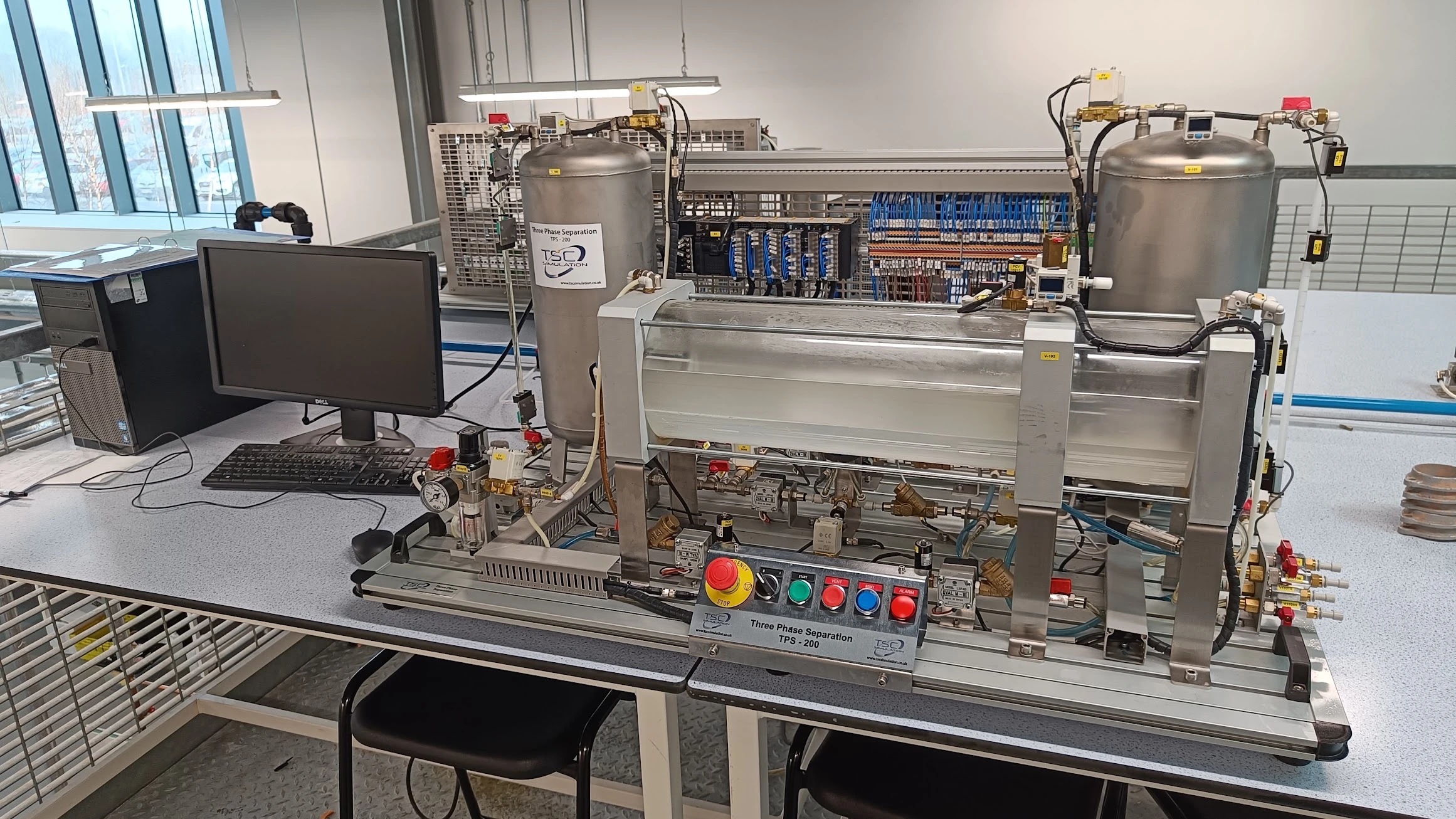
TPS200 three-phase separator at Forth Valley College, with two storage vessels, a transparent horizontal separator, instrumentation and its connected PC. · Photo supplied by Luke Johnson
From an early design to an operational product
Senior engineers put the initial design together in 2012. I picked up the work in October 2013, working with SMC International Training to build the machines and bring the hardware, control logic and software together.
TPS200 became a product I owned throughout its life in service. That meant developing the controls and operator interface, helping customers use it, supporting sales and accounts, creating learning materials and returning to installed machines to service and upgrade them.
A small process plant with real engineering behaviour
The unit demonstrates oil, water and gas separation using air, water and a training oil, isopropyl myristate. Two pressurised storage vessels — V_100 for water and V_101 for oil — feed a horizontal three-phase separator, V_102. The pressure difference drives the mixed feed into the separator; pumps return the separated liquids to their storage vessels.
The transparent separator makes the interface and internal weir visible. Learners can connect what they see in the vessel with the instrument readings, control actions and process behaviour on screen.
| Process element | Engineering and training context |
|---|---|
| Oil and water feed | A master flow controller and ratio setting establish total feed and water fraction through two slave flow controllers. |
| Separator pressure | A software PID controller operates the gas outlet control valve. |
| Liquid levels | Interface-level and oil-side level measurements support level control cascaded to return-flow control. |
| Return circuits | Pump speed and parallel recycle valves provide control across the required flow range. |
| Instrumentation | Pressure, differential pressure, flow, interface level and discrete level switches connect the physical process to the controls. |
| Operator interface | Process graphics, controller faceplates, alarms, trends, events and shutdown displays provide a DCS-style learning environment. |
To give a sense of the unit’s scale, the manual’s example steady-state exercise uses a 0.8 L/min total liquid feed, 50% water, 1.0 barg storage pressure and 0.35 barg separator pressure.
Connecting the PLC, OPC and SCADA
I programmed the OMRON PLC using CX-One, including the automation, digital and analogue I/O handling, and emergency shutdown logic. This required understanding the physical instruments and actuators as well as the software: how signals were wired, how equipment responded and what state it should enter when a trip occurred.
I created the SCADA inside TSC’s simulation engine, using its built-in OPC client. We used OMRON CX OPC Server and also KEPServer to connect the PC software to the PLC. The OPC layer exposed the hardware signals to the operator interface over the network.
The software environment also included an emulation of the hardware for simulation-based practice. That complemented the physical unit and supported learning about operating procedures, measurements and control behaviour.
Tools of the trade — control-valve calibration
The green signal-converter modules translated the PLC’s 1–5 V output into a 0–168 mA current signal to drive the control valves. I trimmed the converters to obtain the required valve response, checking the drive current with a multimeter.
The paired photographs bring the measurement setup and converter hardware together. This was part of making the PLC command, signal conditioning and physical valve behaviour work together during commissioning and troubleshooting.
Tools of the trade — flow-meter interface calibration
The Oval LSF41 geared positive-displacement flow meters produced pulse signals. Accommodating those pulses directly would have required additional PLC input hardware, adding cost and complexity to upgrades of installed machines.
For the electronics, I worked with Michael Bolton, TSC’s Owner and Managing Director. Michael designed the interface units to convert the meter pulses into an analogue current signal, and I installed them. This let us use the existing PLC analogue inputs and made in-place customer upgrades more straightforward.
We calibrated the interface units using a small harness that generated a known, accurate reference frequency corresponding to the meter’s maximum flow. That reference input let us set the interface’s current output to represent the correct full-scale flow signal. The combined image shows the harness, the interface units and the flow meter together.
Making shutdown behaviour visible
The emergency shutdown system runs on the PLC independently of the PC connection or running SCADA model. It monitors conditions such as vessel levels and pressures and applies the corresponding valve, pump and vent actions through a cause-and-effect structure.
I implemented that logic and built the SCADA presentation around it. Learners could connect a process condition with the resulting equipment action, see the trip status and understand the reset sequence. The documentation extracts below show both the engineering matrix and its operator-facing display.
Solving a pump problem in the field
We initially specified the same pumps used on the IPC product. In TPS200 service, the larger pressure differential exposed a problem: over time, pump casings could crack. I handled the servicing and worked through several upgrades for customers while identifying a more suitable solution.
The gallery includes a photograph from 1 September 2014 showing an earlier pump configuration, before the later move to MG2000 pumps.
I selected TCS Micropumps MG2000 pumps to provide the head we needed. Their available flow was too high for the application, so replacing the pumps alone would not solve the system problem. We adapted other equipment on the unit and repurposed the flow control valves to act as recycle valves.
The revised control arrangement combined pump speed with recycle-valve position. At low flow demand, the pump could remain at its minimum operating speed while the recycle path opened; at higher demand, the recycle valve closed and pump speed increased. The SCADA had to express and control that revised arrangement coherently.
The photographs show my final mounting design with the parallel recycle flow-control valve, alongside the pump power-supply boards using EQIMG2 drivers supplied by TCS Micropumps.
I carried the change through equipment specification, testing, control and SCADA design, physical packaging and installation at customer locations. Customers received an in-place upgrade to their existing units. For me, it was a practical lesson in owning the behaviour of the complete system, from pump selection to the experience of the person operating it.
Upgrading the oil-level differential-pressure measurement
The original oil-level differential-pressure sensor was an SMC PSE550, selected because it had been used on the IPC product. In TPS200 service, we found it was susceptible to damage at elevated pressure. Its gas-service design was not a good fit for this application, so the task was to replace it with a more suitable instrument and make that replacement practical for existing machines.
I replaced it with an Omega PX419-10WDDUI differential-pressure transducer and developed the fitment to integrate it into the TPS200 hardware. The installation photographs show the replacement instrument and the arrangement I developed.
I installed the upgrade across all customer sites over time, carrying the change from component selection and mechanical fitment through to field installation. Like the pump work, this was part of owning and improving the complete product throughout its life in service.
Matching level switches to the training oil
Oil detection needed more sensitive capacitive level switches. Water is strongly polar and has a high dielectric constant, making it comparatively easy to detect. The training oil, isopropyl myristate, is an ester with a much lower dielectric constant, so it produces a smaller change in capacitance.
I specified Omron E2K-L13MC1 level switches with the sensitivity needed to detect the oil in this installation. The photograph shows the replacement detectors fitted beside the vessel. It was another practical example of troubleshooting the complete system and matching the equipment specification to the fluid being measured.
Different learners, different requirements
I created learning materials around customer requirements for both vocational training and undergraduate chemical engineering courses. Those audiences needed different approaches: practical familiarity with equipment, instrumentation and procedures on one hand, and deeper exploration of separation behaviour and control relationships on the other.
The same hardware supported discussions of residence time, feed composition, level and pressure control, PID tuning, cascade and ratio control, and shutdown cause and effect. My role included shaping the learning material to fit the course, alongside ensuring that the unit and its software supported the exercises.
At Forth Valley College
The photographs below show TPS200 in use as teaching equipment at Forth Valley College, including an installation alongside an IPC process-control trainer. They connect the product’s hardware and controls with its day-to-day classroom setting.
Watch the TPS200 video at Forth Valley College on Google Photos.
Worldwide delivery and long-term ownership
Units were delivered to Canada, Nigeria, Iraq and the UK. I travelled with them for customer work and took the products to conferences in Abu Dhabi and Dubai, combining demonstrations and sales support with installation, service and ongoing customer relationships.
Supporting the product made electronics, wiring and hands-on engineering core skills. I developed the ability to read mechanical and electrical drawings, select equipment, diagnose faults and make practical changes to working machines, while continuing to manage the software and customer experience.
TPS200 brought together product ownership, automation, SCADA, OPC integration, learning design, sales, account management and field service. The responsibility extended from making the first design work to keeping installed products useful for customers around the world.
My work on TPS200
My TPS200 work began in October 2013, following the senior engineers’ earlier concept work. The pump and recycle-control upgrades were around April 2016. I retained product ownership through my departure in October 2026.
Equipment & operating context
A closer look.
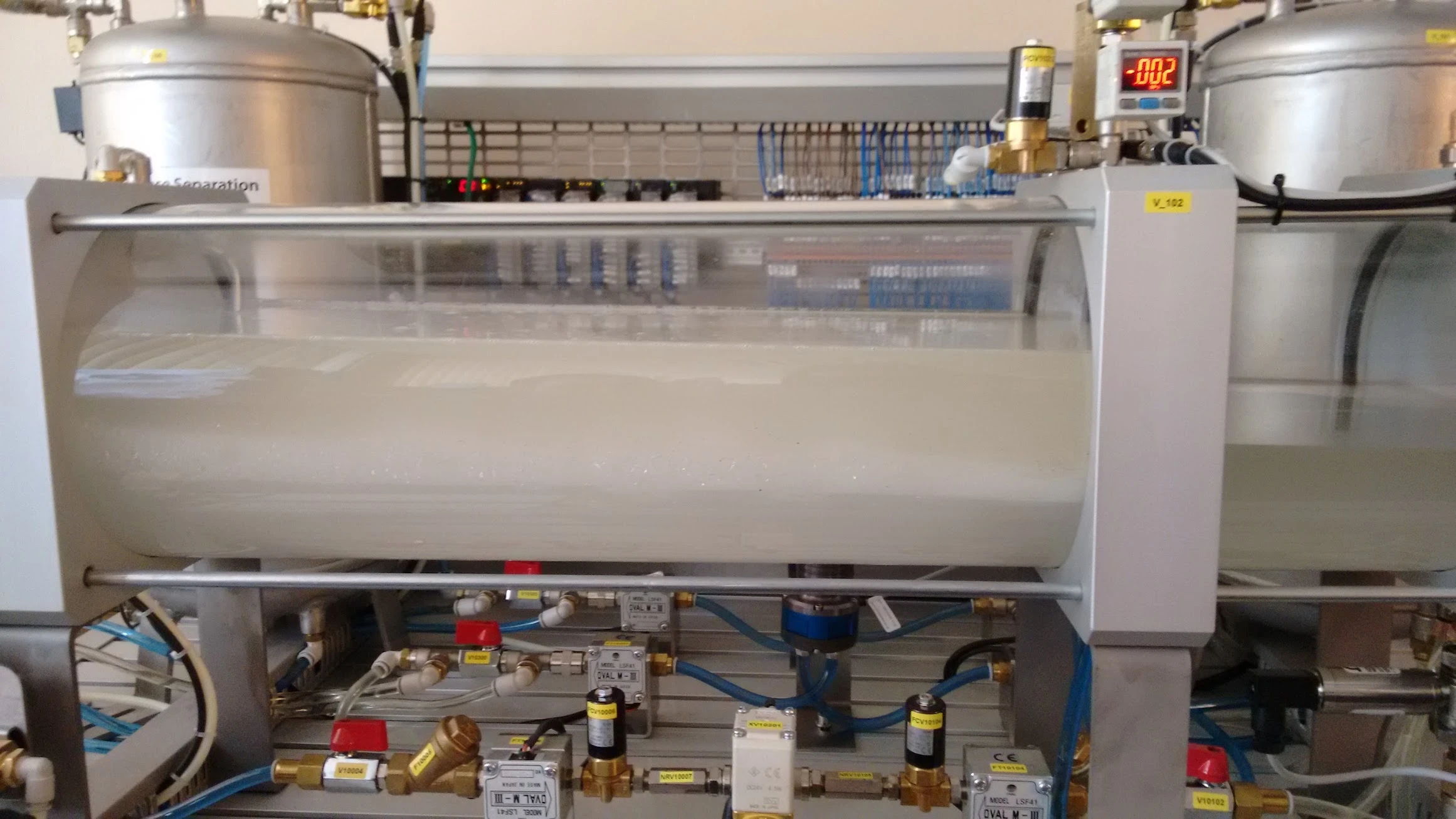
TPS200 in operation — oil on top, water below, and a mixed oil-and-water layer forming a wedge along the length of the separator as separation takes place.
Photo supplied by Luke JohnsonTPS200 at Forth Valley College. The transparent separator and accessible instruments make the physical process visible to learners.
Photo supplied by Luke Johnson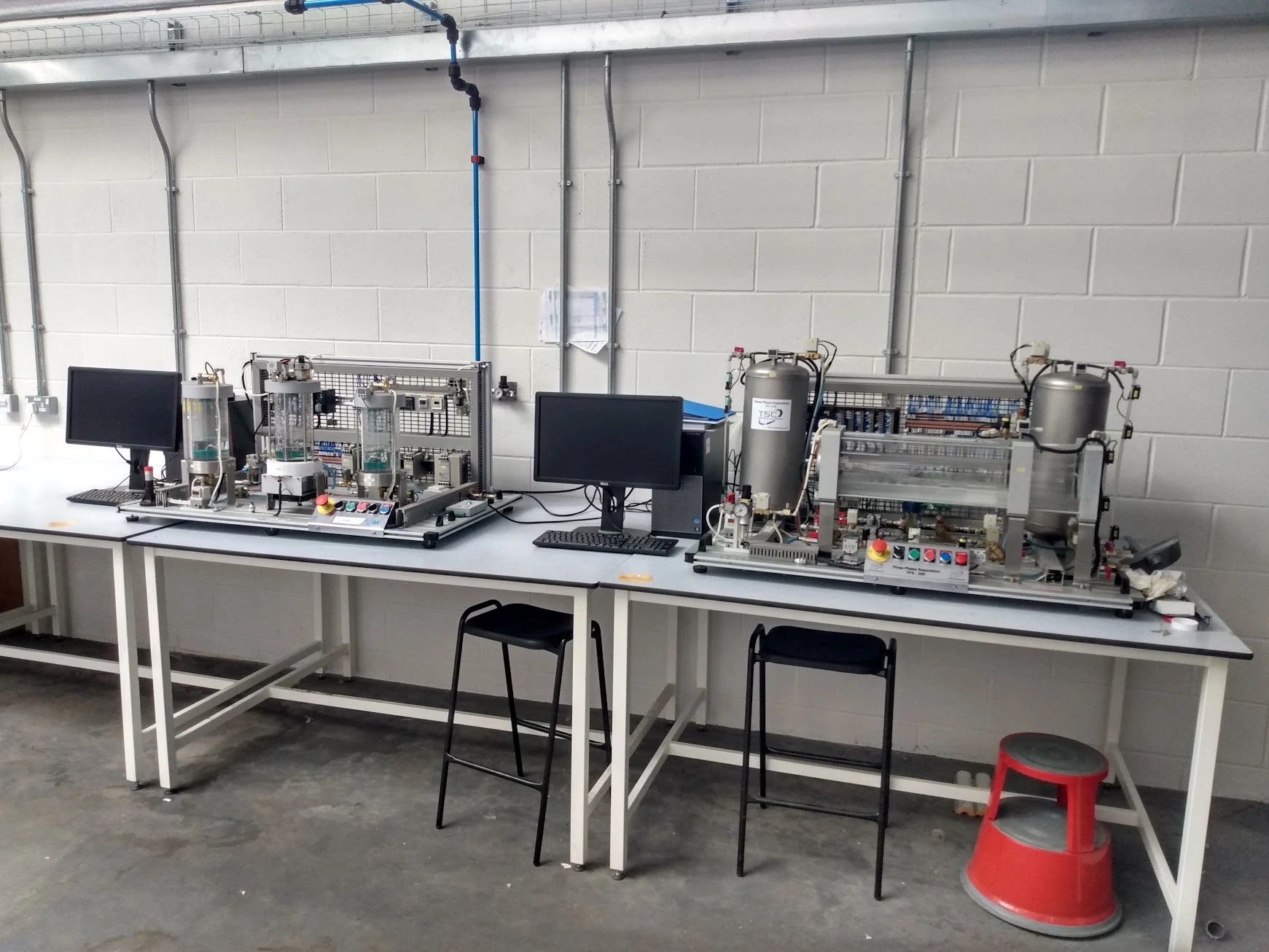
IPC and TPS200 installed side by side at Forth Valley College, each with its connected PC interface.
Photo supplied by Luke Johnson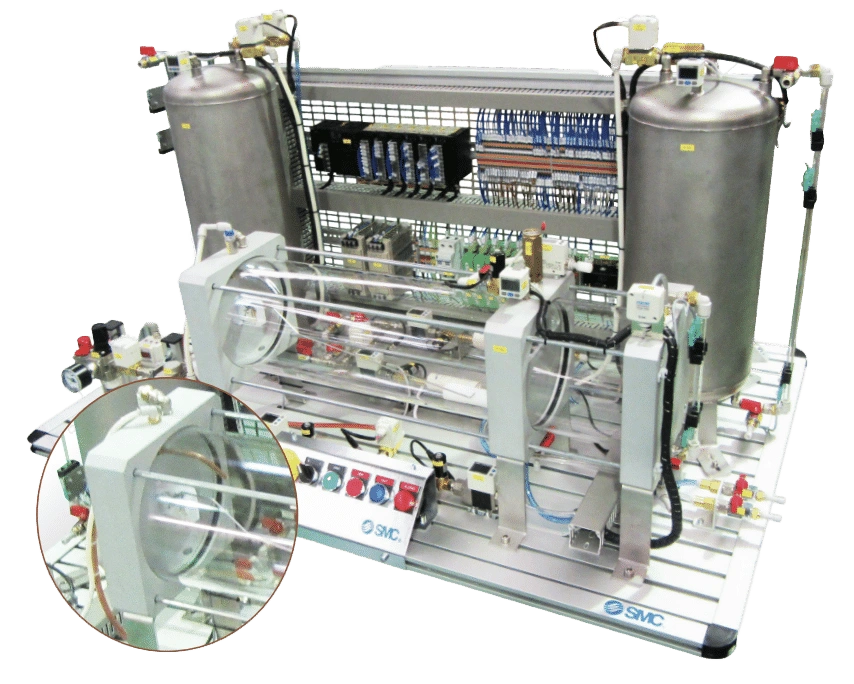
The physical training unit brings vessels, instruments, valves, pumps and PLC hardware together on a compact frame.
SMC International Training, via DAKTIC ↗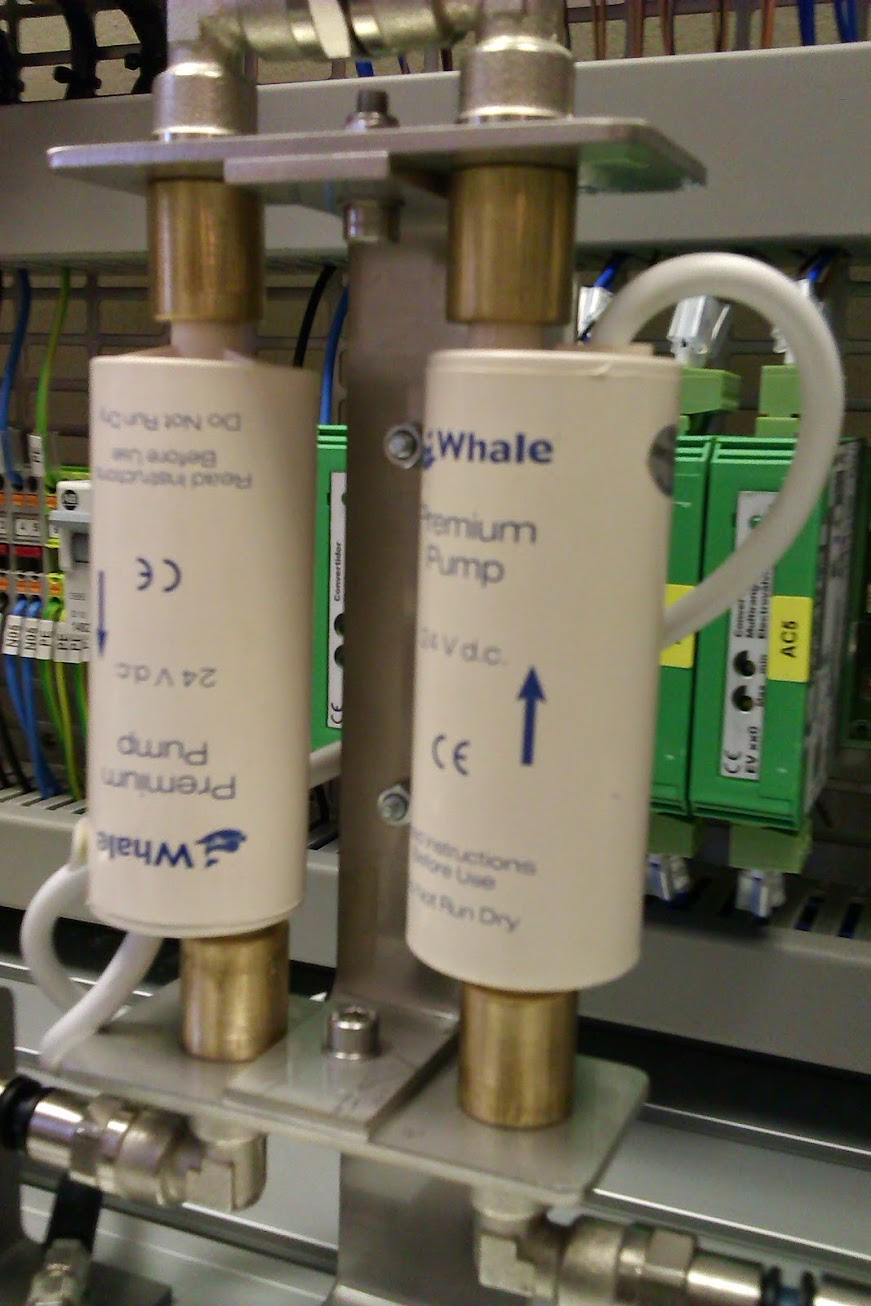
TPS200 pump configuration photographed on 1 September 2014, before the later change to TCS Micropumps MG2000 pumps.
Photo supplied by Luke Johnson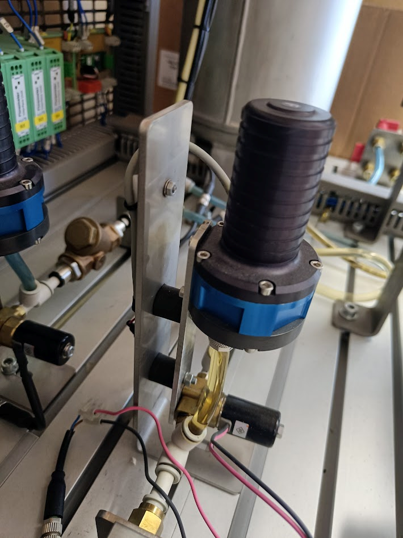
My final MG2000 mounting design, with a recycle flow-control valve in parallel to allow precise control of forward flow.
Photo supplied by Luke Johnson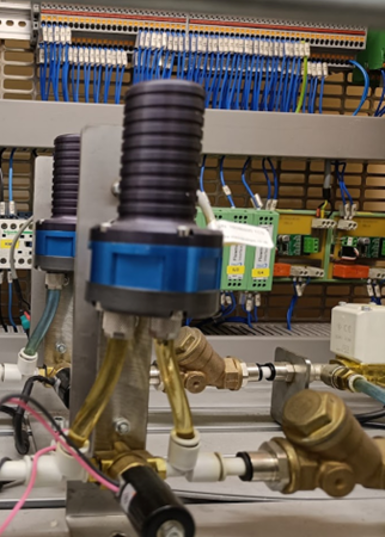
A second view of the final MG2000 installation and parallel recycle arrangement.
Photo supplied by Luke Johnson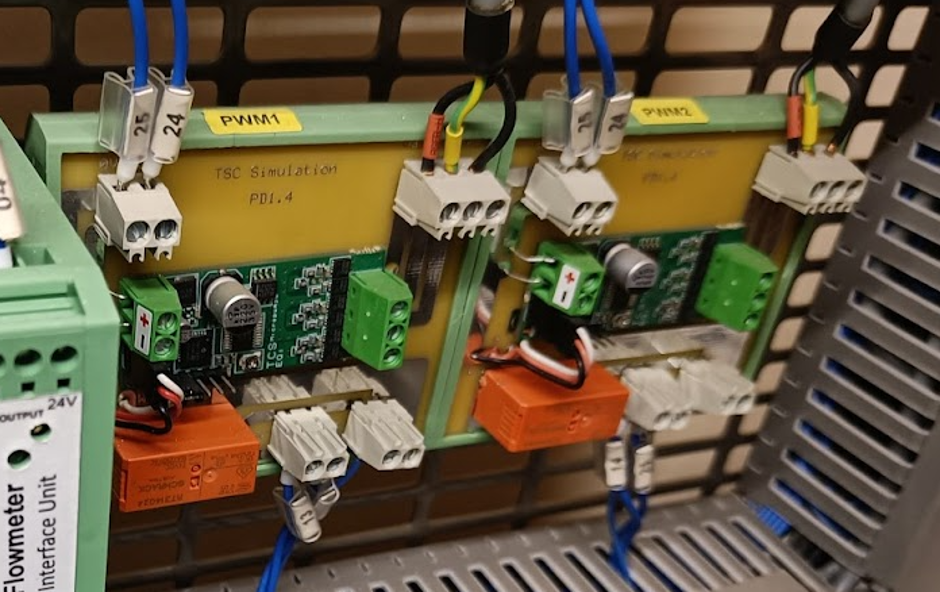
Final pump power-supply board assemblies using EQIMG2 drivers supplied by TCS Micropumps.
Photo supplied by Luke Johnson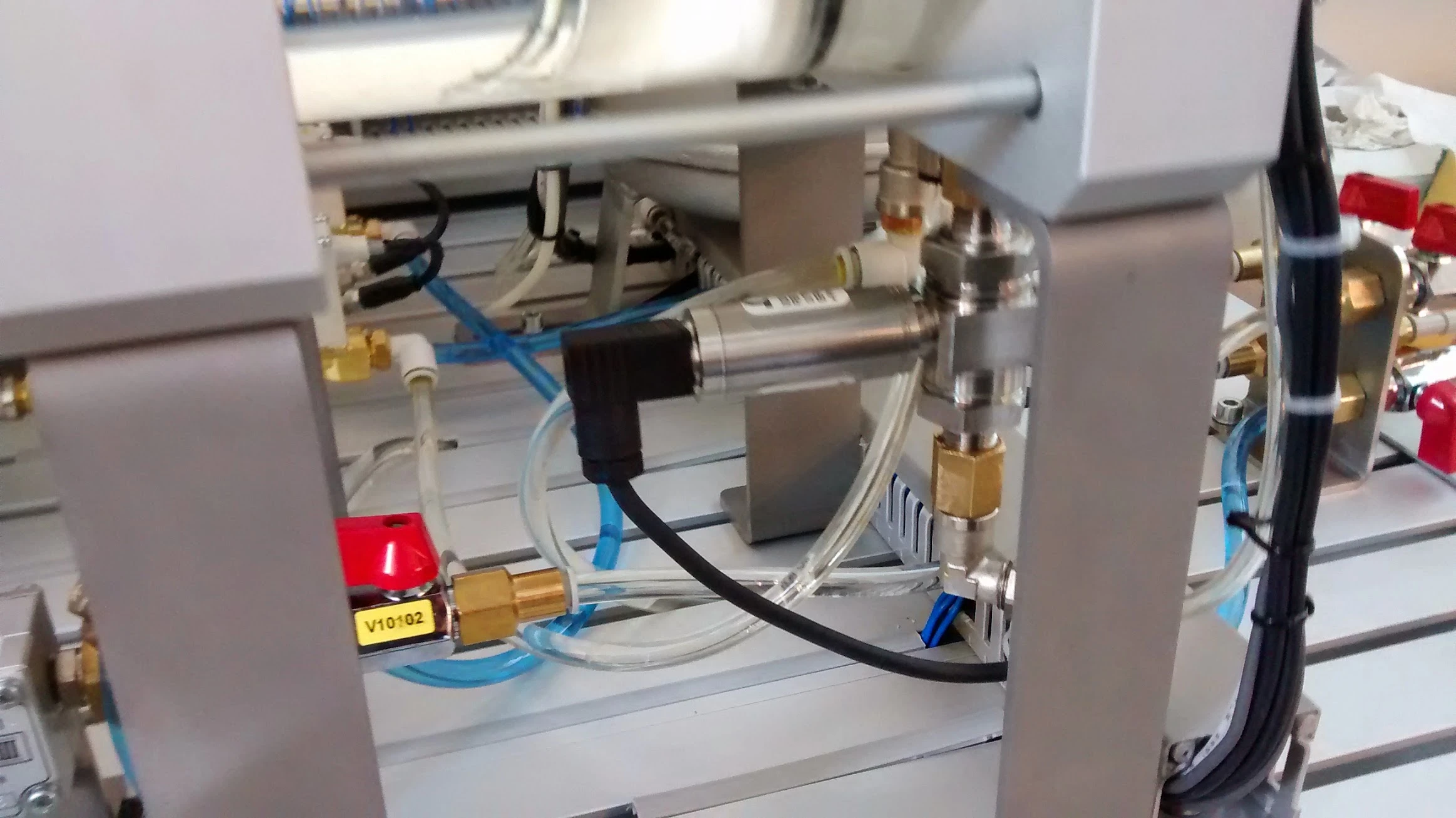
The Omega oil-level differential-pressure transducer installed using the fitment I developed for TPS200.
Photo supplied by Luke Johnson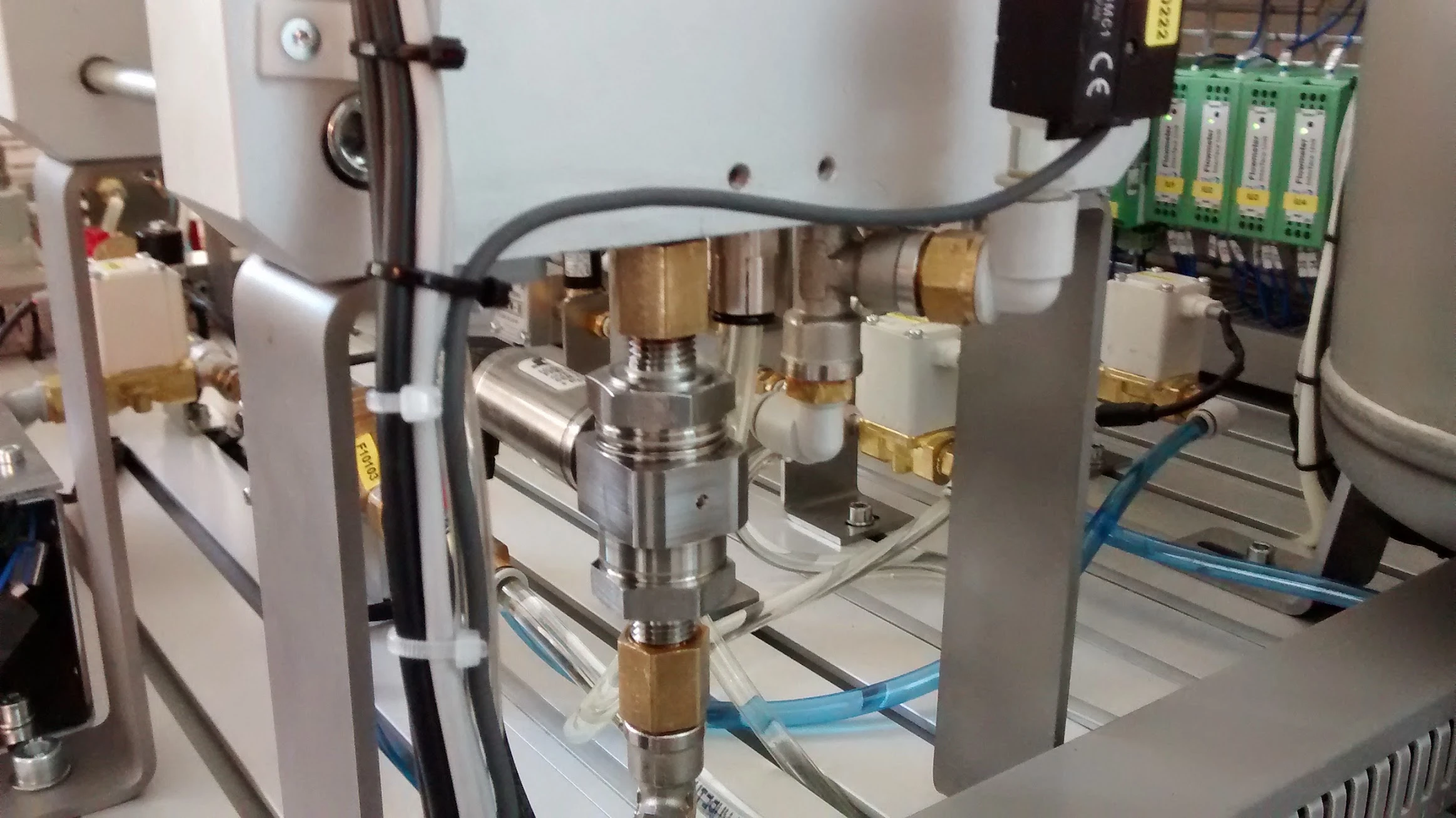
A second view of the replacement transducer and its connections. I rolled this upgrade out across all customer sites over time.
Photo supplied by Luke Johnson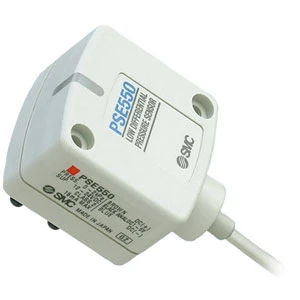
The original SMC PSE550 sensor type, carried over from the IPC design and later replaced in the TPS200 oil-level measurement application.
SMC · reference image supplied by Luke Johnson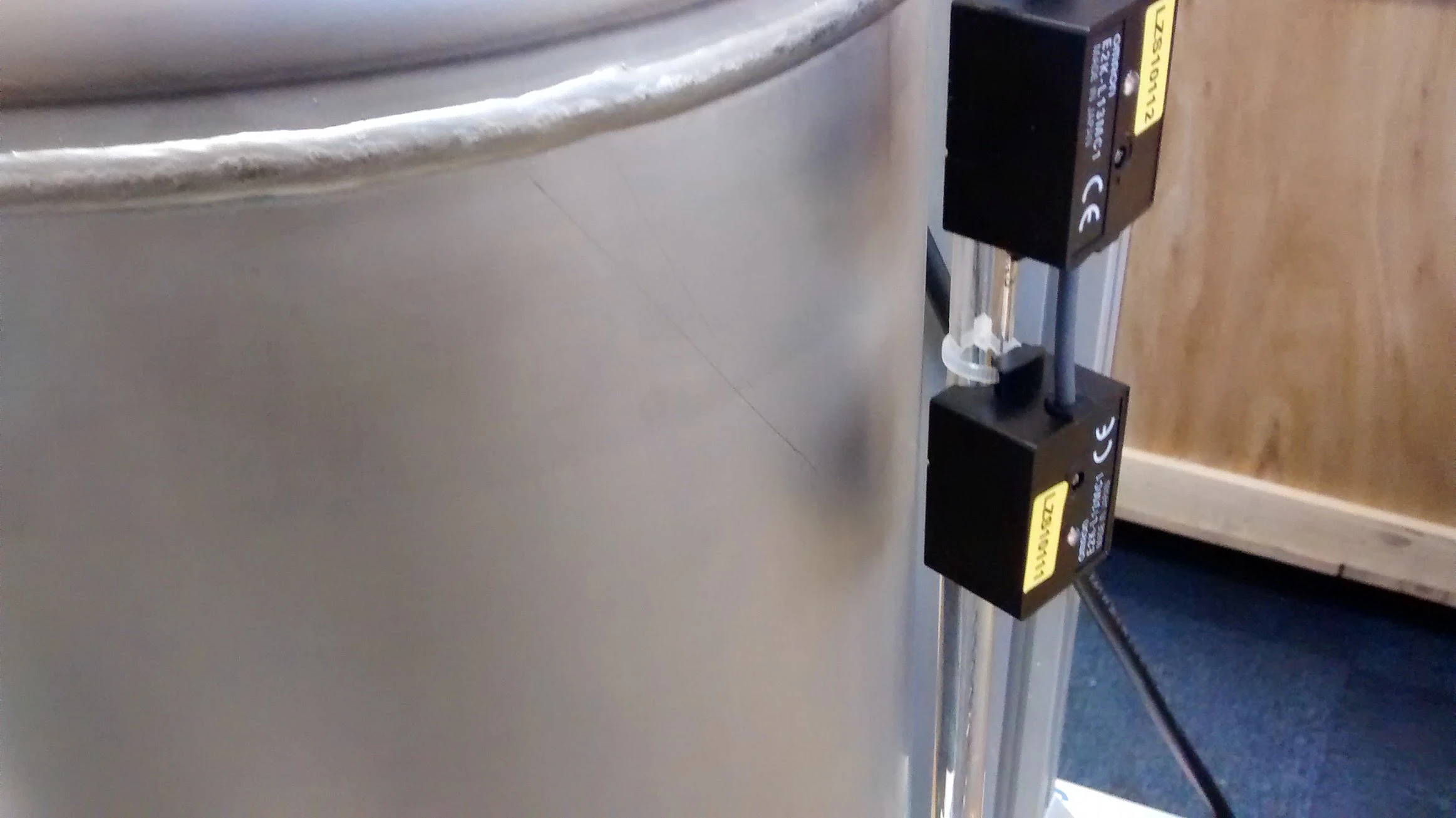
Omron E2K-L13MC1 level switches selected for their greater sensitivity so the isopropyl myristate training oil could be detected.
Photo supplied by Luke Johnson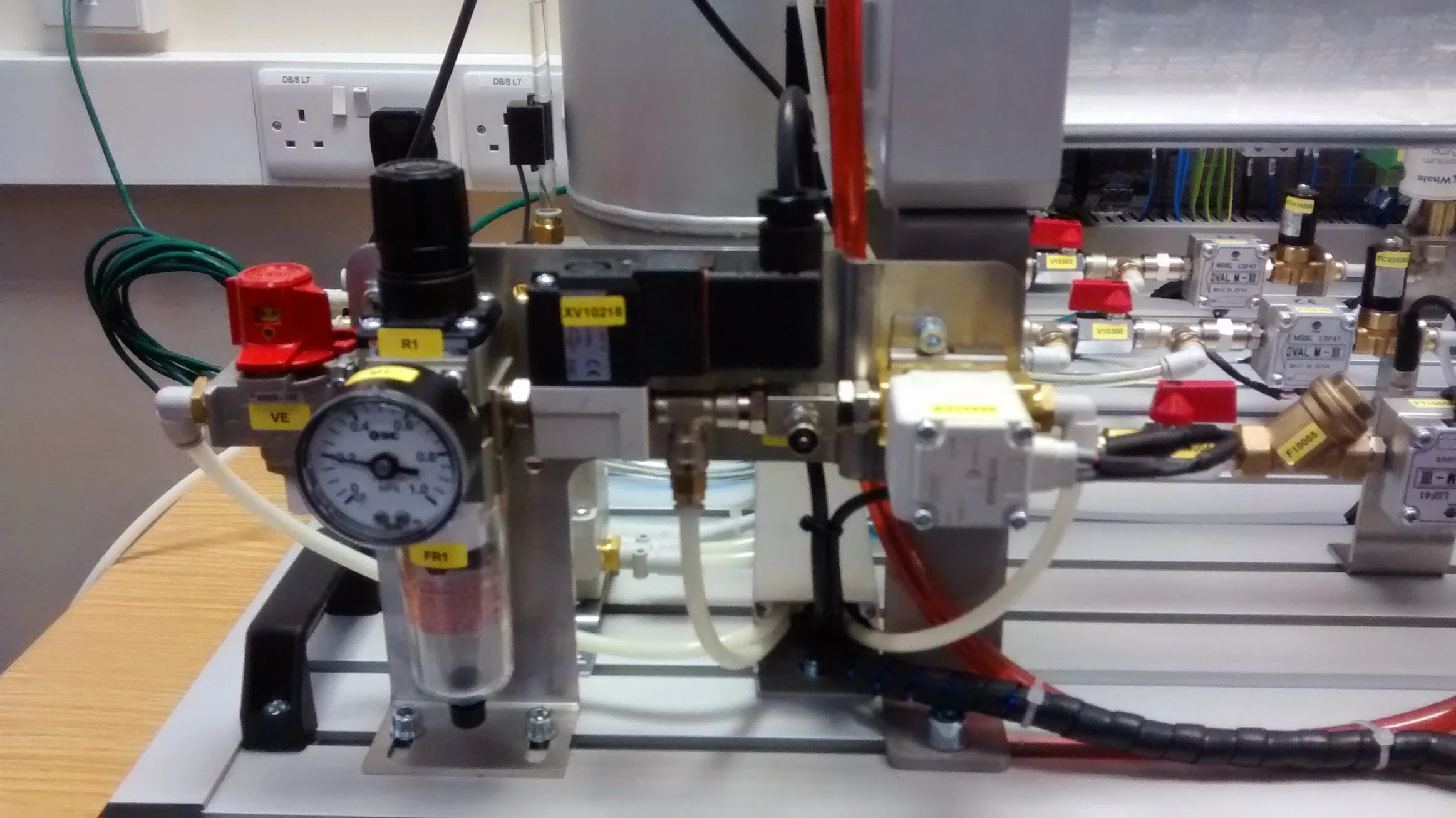
TPS200 air supply with an inlet isolation valve, regulator, three-way venting valve, a needle valve providing a pressure drop in the separator supply, and a separate isolation valve for the air connection to the separator vessel.
Photo supplied by Luke Johnson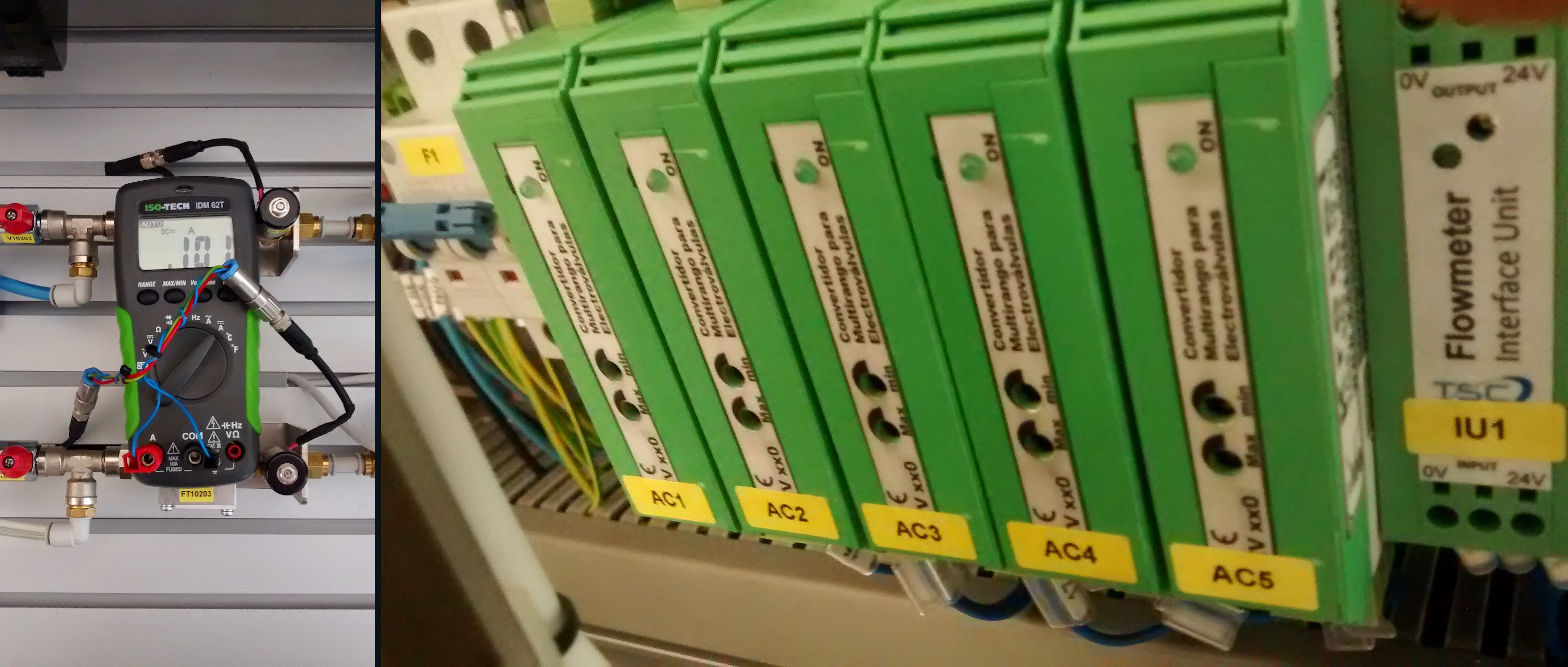
Tools of the trade — control-valve calibration. Checking valve-drive current with a multimeter and trimming the signal-converter modules for the required valve response.
Photos supplied by Luke Johnson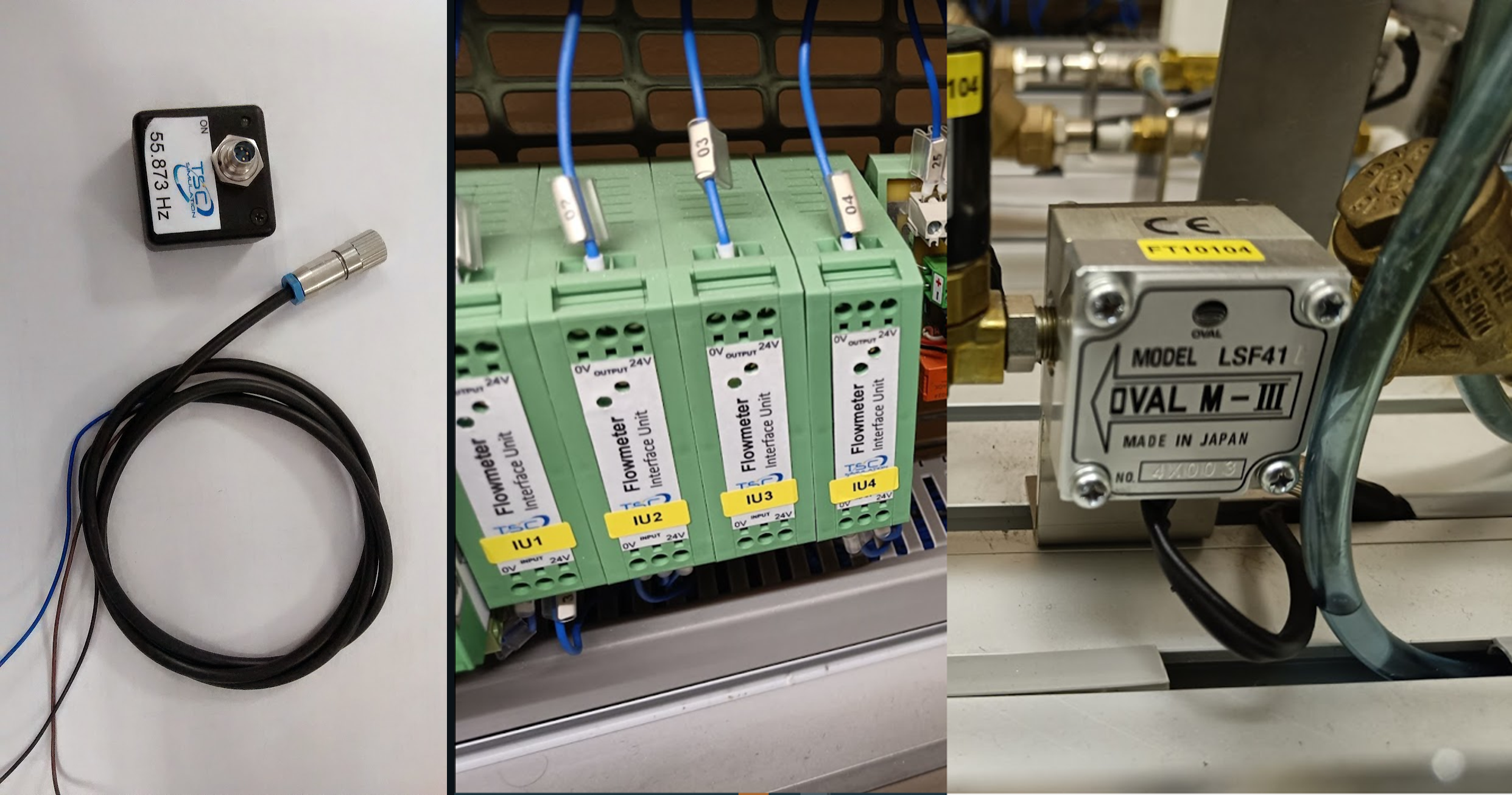
Flow-meter interface calibration — reference-frequency harness on the left, interface units designed by Michael Bolton and installed by me in the centre, and an Oval LSF41 flow meter on the right.
Photos supplied by Luke Johnson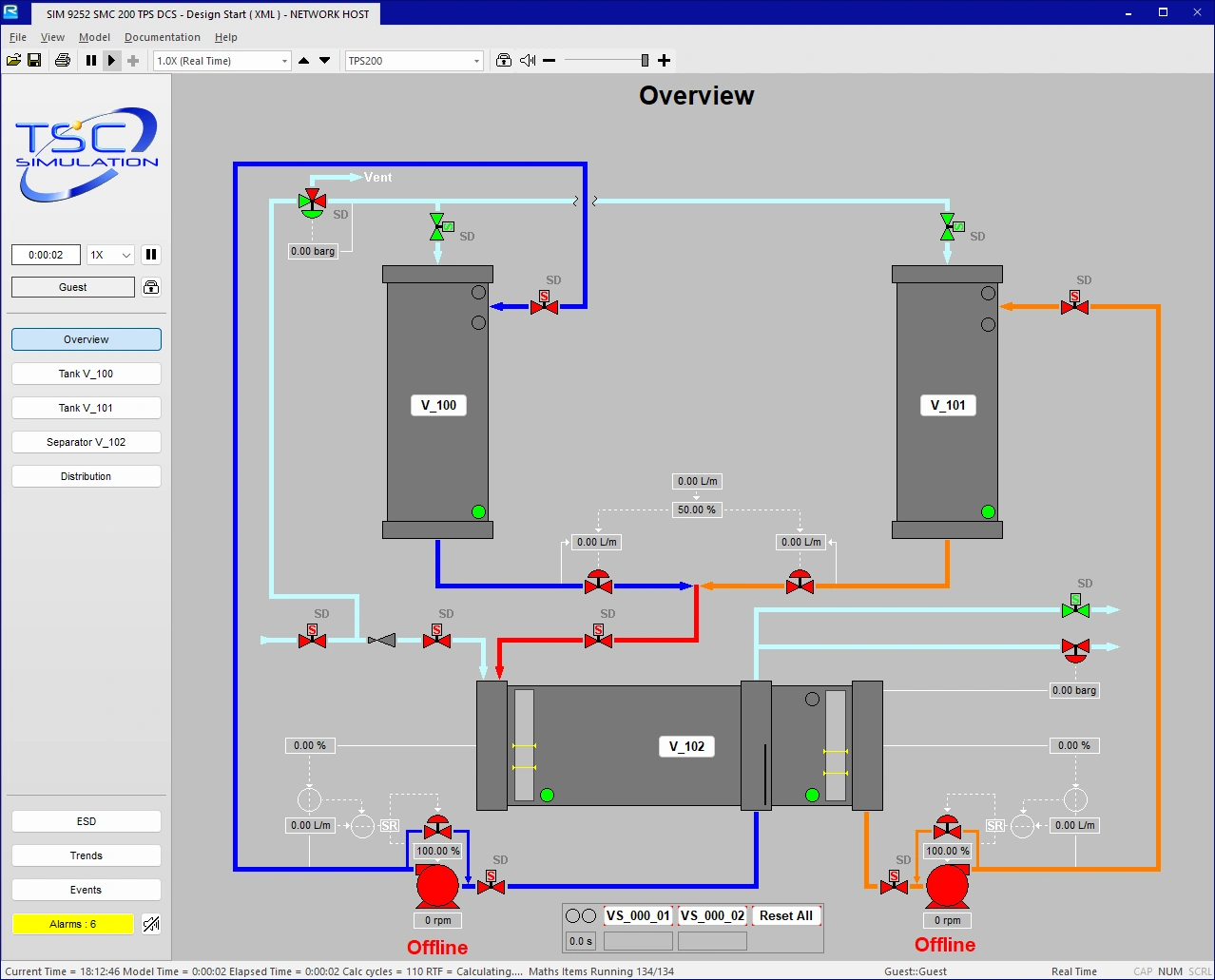
The SCADA overview I created within TSC’s simulation engine, shown in its offline state.
TSC Simulation / screenshot supplied by Luke Johnson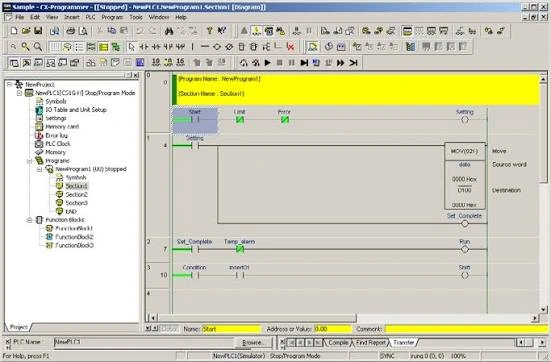
An illustrative view of OMRON’s CX-Programmer ladder-logic environment, part of the CX-One toolset I used for PLC development. This reference image shows the working environment, not actual TPS200 code.
OMRON software interface / reference image supplied by Luke Johnson ↗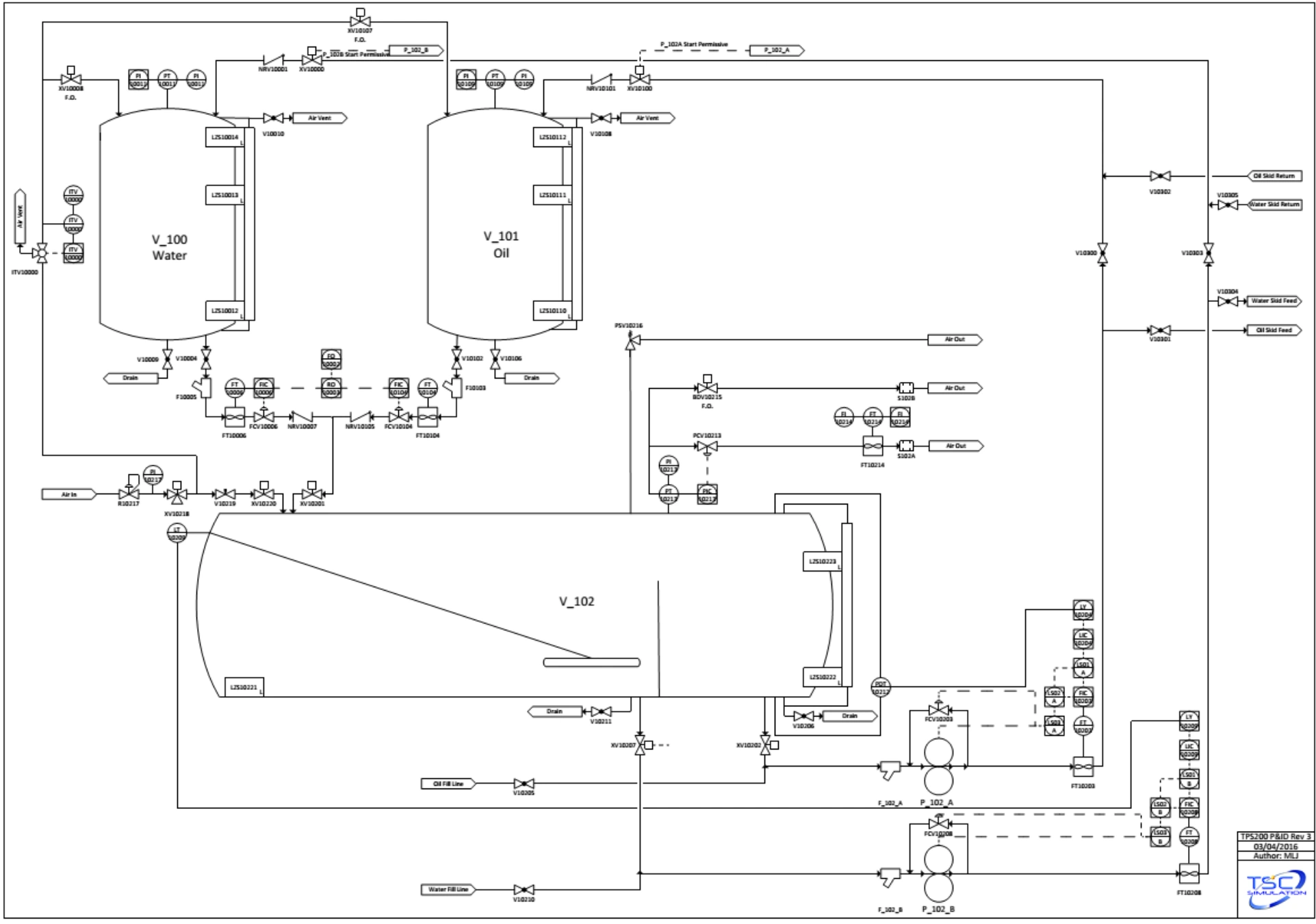
The P&ID from printed page 68 of the TPS200 documentation, rotated for reading. It connects the physical process layout with the instruments and controls.
TSC Simulation, TPS200 Documentation, Rev E, page 68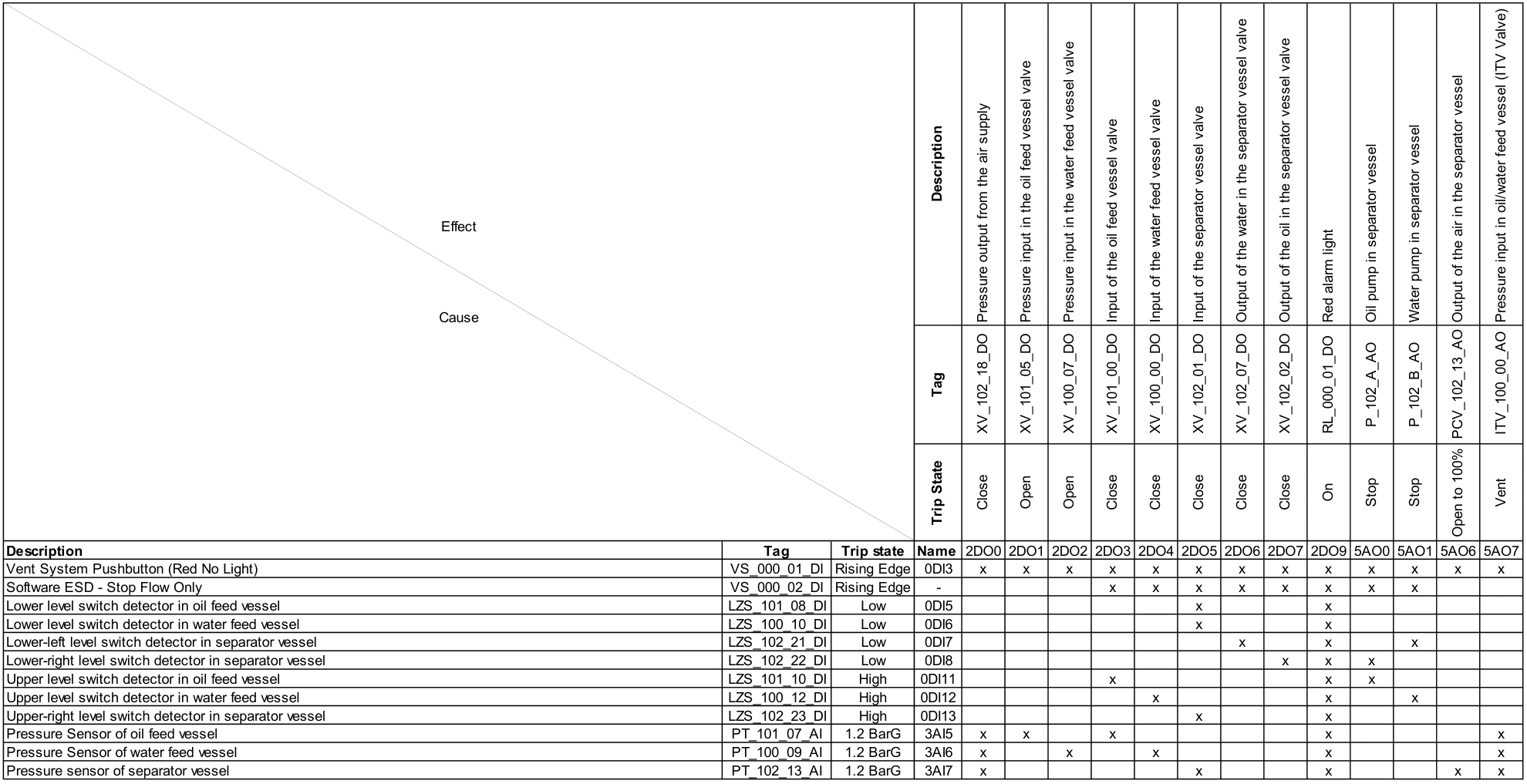
The documented cause-and-effect matrix from printed page 65. It shows how individual trip causes map to executive actions in the PLC shutdown system.
TSC Simulation, TPS200 Documentation, Rev E, page 65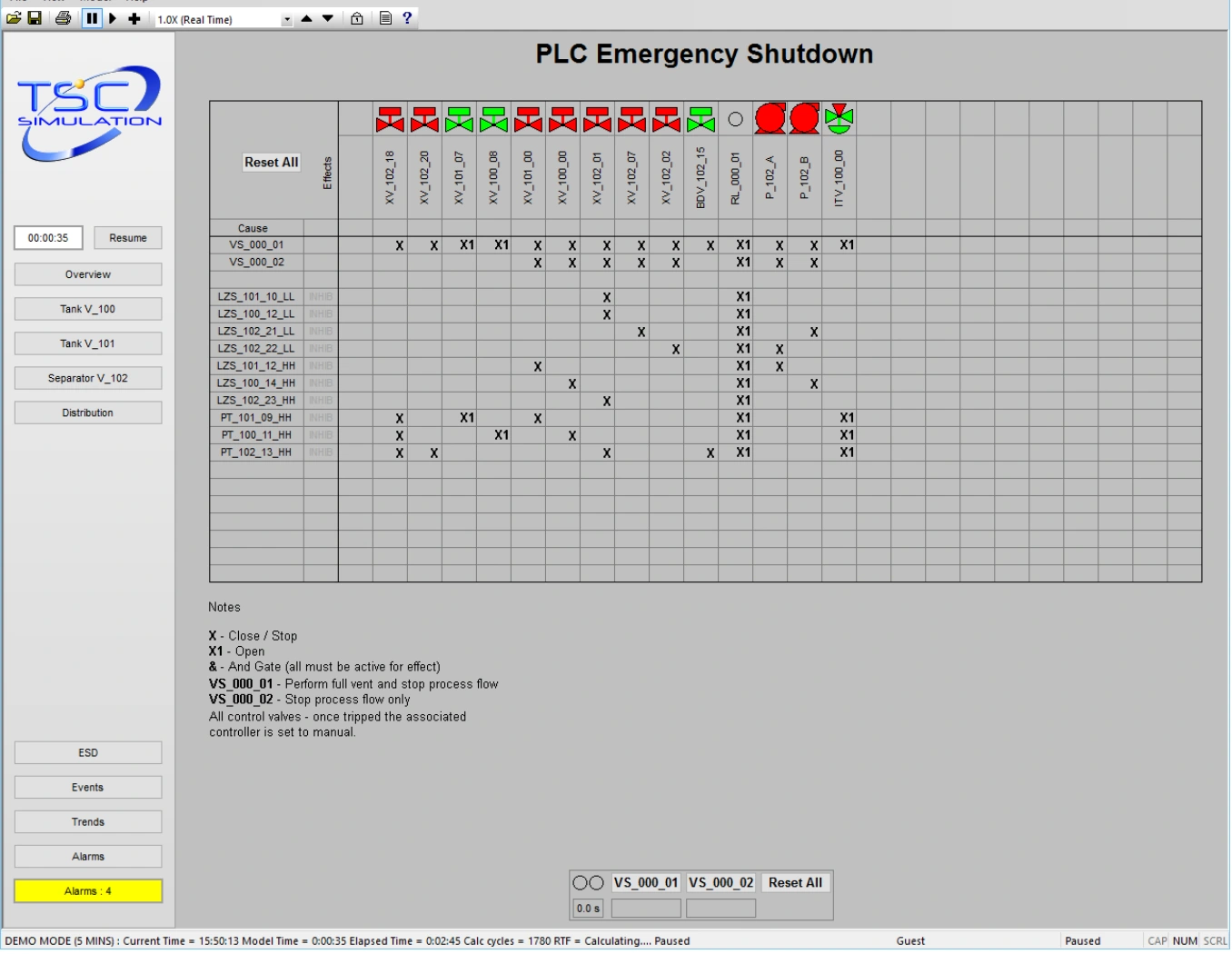
The SCADA emergency shutdown display from printed page 74 makes the relationship between causes, equipment states and reset behaviour visible to the learner.
TSC Simulation, TPS200 Documentation, Rev E, page 74Further context
Technical references and related project information.
- OVAL FLOWMATE LSF series — positive-displacement meters with pulse output ↗
- Sparling/OVAL Flowmate LSF — technical specifications (PDF) ↗
- Omron E2K-L capacitive liquid-level sensors — specifications ↗
- SMC PSE550 operating manual — applicable fluids and specifications ↗
- Omega PX419-10WDDUI — wet/dry differential-pressure transducer data ↗
- TPS200 product description and equipment imagery ↗
- TSC hardware training demonstration — TPS200 and IPC201 ↗