Personal project / Luke Johnson
Building My Engineering Portfolio.
Designed and built an AI-assisted, self-hosted portfolio that expands my CV into a visual career timeline, project case studies and a growing showcase of engineering and software development capabilities.
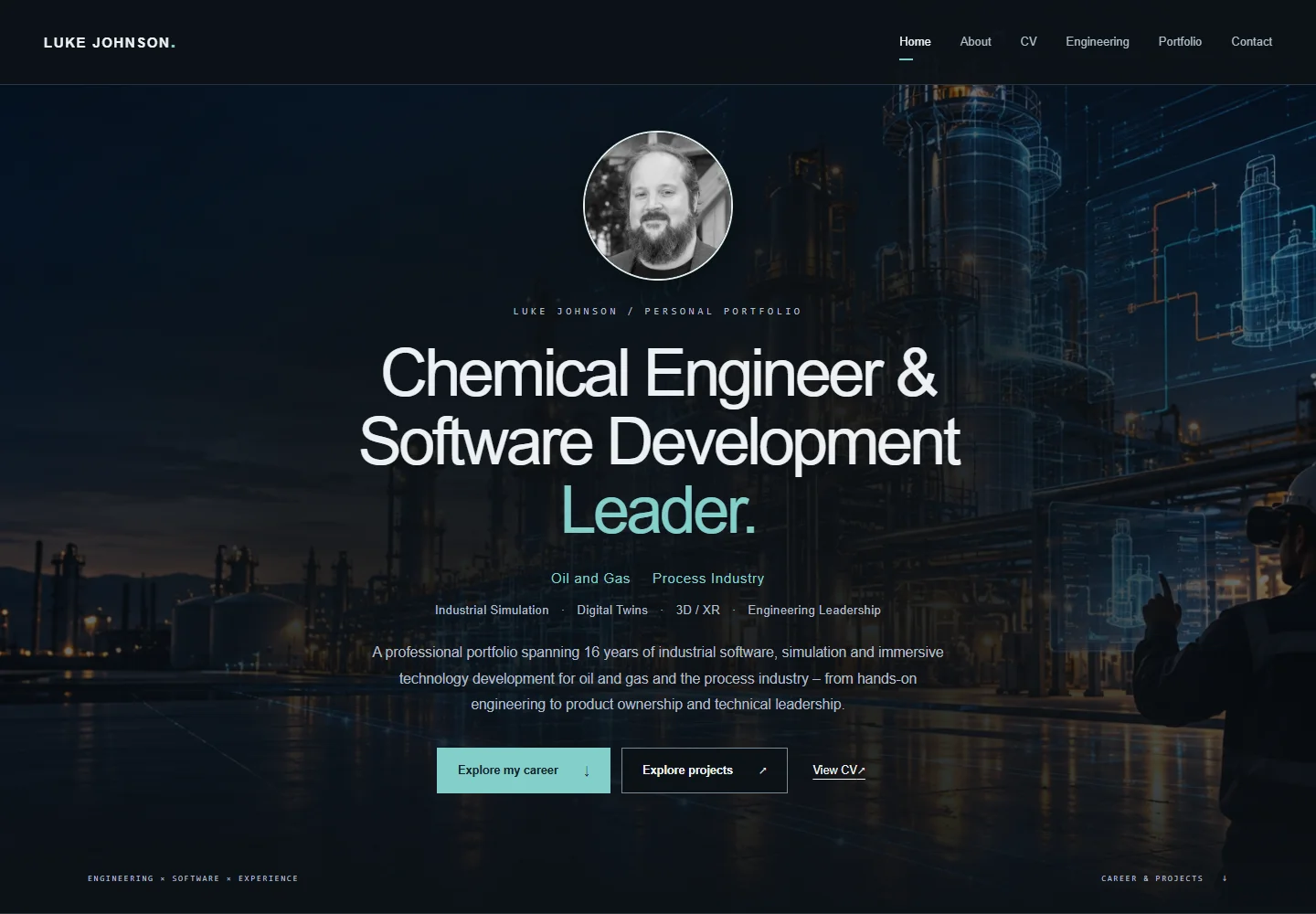
Luke Johnson · personal portfolio
Situation
My CV could outline my experience, but it could not show the projects in enough depth: the engineering behind them, the products, the decisions and my contribution. For 3D/XR opportunities, I also needed a visual portfolio with images and demonstrations of the work.
I wanted a supporting resource where recruiters could get a quick overview and technical readers could explore further. It would let me chronicle experiences and competencies beyond the space available on a CV, then continue growing as I took on new work.
My experience in website sales and marketing helped shape how I wanted to present that history. Building the site was also an opportunity to demonstrate web development and the practical use of AI development tools.
Task
Build a modern, visual engineering and technology portfolio that I could host on my own server to keep ongoing costs low. It needed a suitable content architecture, a simple CMS option and an easy way to add or amend projects without rebuilding every page by hand.
The job search was already active, so speed mattered. The aim was to get a useful site online quickly and keep expanding it. AI-assisted development offered a practical way to deliver that first version while I concentrated on the content and the decisions that needed my input.
Action
I began with ChatGPT to develop a plan, then used OpenAI Codex to build the site from that brief. I set the requirements, reviewed the results and refined the design and behaviour through working versions.
Choosing a maintainable architecture
The architecture kept the live website simple and put content editing in the local development workflow.
| Choice | Why it suited the project |
|---|---|
| Lightweight website | Reusable page layouts and straightforward hosting keep the site easy to maintain. |
| Structured content | Shared records connect accounts, projects, products, roles and milestones without duplicating the history across pages. |
| Simple content editing | A CMS option and editable project files make it easy to add material and amend existing pages. |
| Hosting on my own server | Uses resources I already have to keep ongoing costs low. |
| Version control and repeatable publishing | Preserves reviewed changes and provides a consistent way to update the live site. |
Building the content and the career timeline
I collated my CV, project material, images, demonstrations and work history, and researched public announcements and blog posts about the projects and products to add supporting context and references. I then worked with Codex to turn that material into project pages. The visual approach puts concise descriptions and imagery first, with the engineering detail available when someone clicks through.
As more projects accumulated, I revised the plan. A gallery alone did not explain when the work happened or how it related to my career. Some customer pages also covered several separate deliveries over many years.
Before developing the timeline, I reviewed the content hierarchy, dates, responsibilities and relationships. We split distinct deliveries into project records, grouped them under customer accounts and connected them to products and career roles. The homepage timeline, portfolio and project pages now draw on those shared records.
Reviewing and refining the result
Development was iterative: review a working page, adjust the content or layout, check it and build again. I used Git to preserve progress and checked responsive layouts, navigation, media, content relationships and accessibility as the site grew.
AI helped with planning, implementation, research and drafting. I supplied the project knowledge, chose what belonged on the site and reviewed the technical accuracy and presentation. Collating the career history has required more work than generating the page structure, and AI has also helped organise that material into something readable.
Result
I now have a functional portfolio site that supports my CV with a visual career history and detailed project accounts. It gives me a place to explain the work, show the outcomes and develop a broader capability showcase over time.
The site is self-hosted, straightforward to update and still growing. New content can use the existing templates and shared records, so each additional project builds on the structure already in place.
AI-assisted development made it practical to get a working site online in hours and days. That speed mattered during an active job search and let me spend more time gathering and reviewing the career material.
For me, this project demonstrates appropriate use of AI: applying it to planning, implementation and time-critical work, while keeping direction, judgement and review with me. Choosing where the tools are useful is part of the skill.